
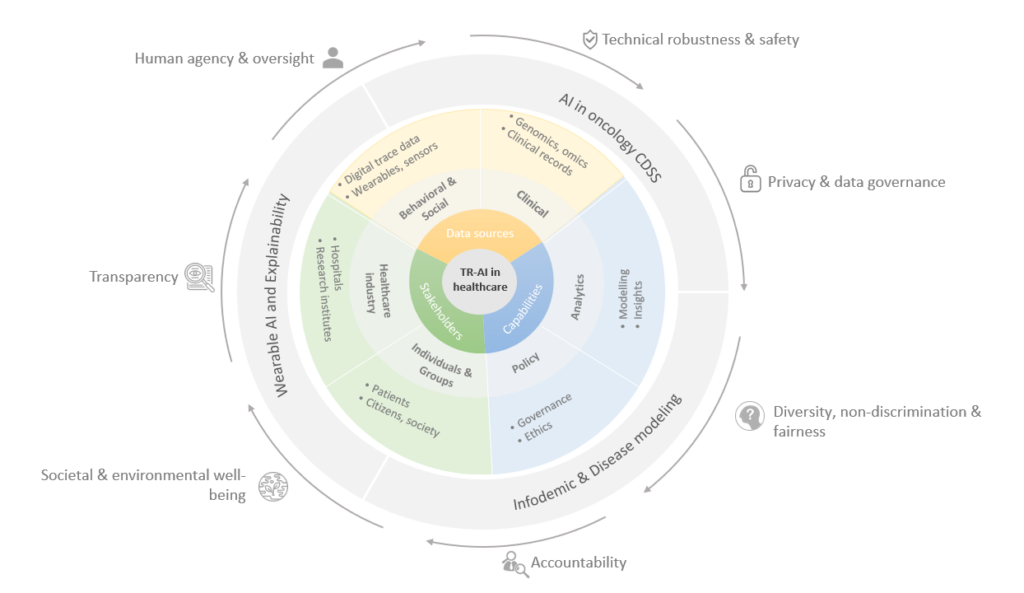
Artificial intelligence is increasingly used to support decisions across healthcare—from patient-facing tools and emergency department workflows to hospital analytics and administrative processes. Despite this rapid adoption, critical challenges remain regarding the transparency, interpretability, and real-world usability of AI systems. Clinicians, patients, and healthcare organizations often struggle to understand how AI models generate predictions, when they can be trusted, and how they influence decision-making. Existing evidence also highlights uncertainties around workflow integration, patient benefit, and the practical conditions under which AI meaningfully improves healthcare.
RAI4Health addresses these challenges by advancing Responsible AI approaches that prioritize transparency, reliability, and meaningful clinical and organizational impact.
Approach and Methods
RAI4Health builds on a research program that combines methodological innovation, transparency and interpretability research, and evidence-informed framework development, grounded in both technical and user-centered perspectives.
Methodological innovation in machine learning, including hybrid association rule mining with autoencoders, clustering-based personalized care models, dynamic event network models, and anomaly detection techniques.
Transparency and interpretability research, examining how AI outputs can be made more understandable and clinically relevant, including work on association rule explanations, interpretable prediction models, and the clarity of information delivered by large language models for patients.
Human–AI interaction and usability evaluations, assessing how clinicians and patients understand and use AI-generated information—in contexts such as emergency medicine, rare disease communication, and clinical decision support.
Evidence-informed and conceptual frameworks, derived from systematic and scoping reviews, including work on blockchain value in healthcare, sustainable and responsible data science processes, and evaluations of generative AI in clinical and patient-facing settings.
Researcher

Dr. Pavlina Kröckel
Lange Gasse 20
90403 Nürnberg
- Phone number: 09115302-95477
- Email: pavlina.kroeckel@fau.de
Partner